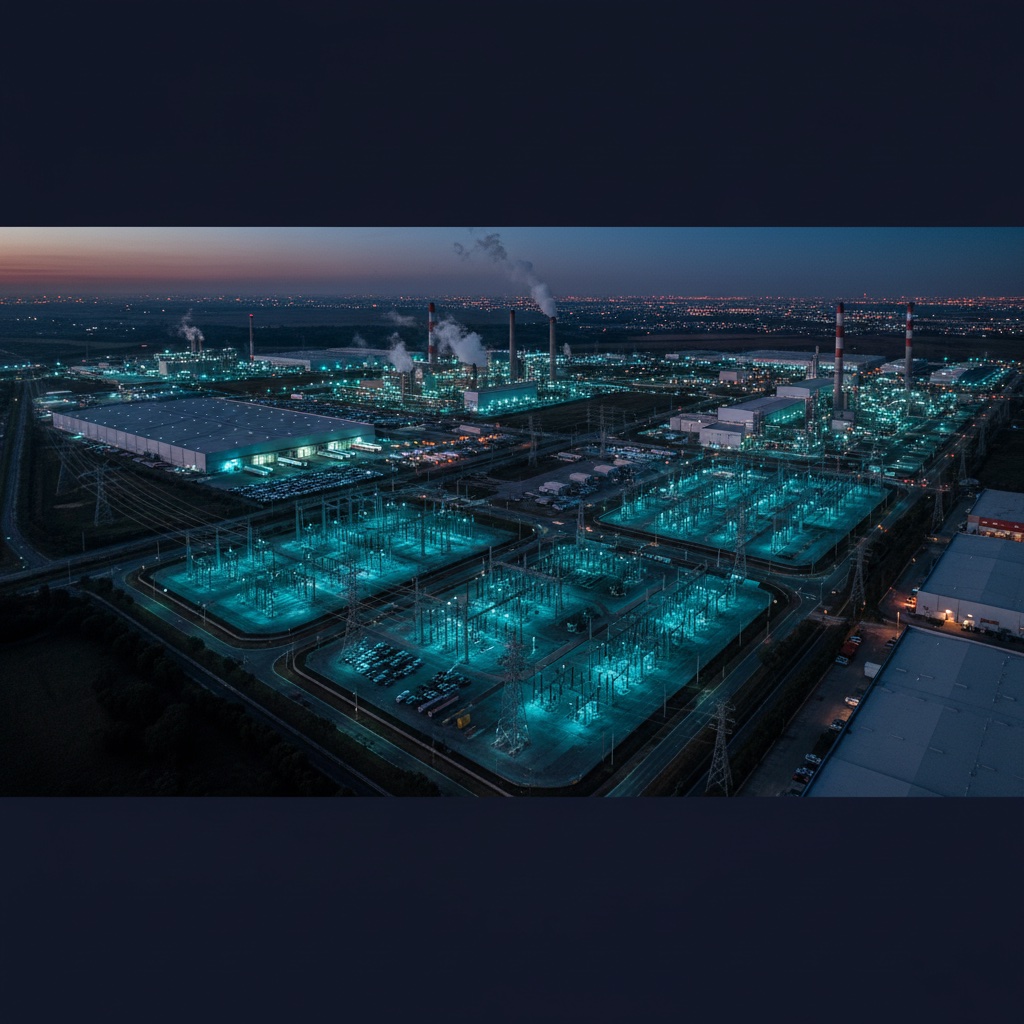
Electricity represents between 8% and 25% of operating cost for a Mexican industrial plant, depending on the sector. In steel or cement it reaches 40%. It is one of the few line items where well-made decisions can release several million pesos a year without touching production volume, headcount, or capital investment in the production line.
And yet, most companies attack this cost the wrong way: replacing lamps with LEDs, buying efficient motors, or installing solar panels on the plant. All of that contributes —but as we'll see, those are just one of three levers. Real industrial energy optimization operates on how you consume, how you buy, and how you operate. This guide is the complete map.
What is industrial energy optimization?
Industrial energy optimization is the set of technical, contractual, and operational decisions that minimize total energy cost without compromising production. It should not be confused with three close concepts:
- Energy efficiency = consuming fewer kWh for the same production output. It is just one lever.
- Energy savings = reducing consumption, generally via efficiency or activity reduction.
- Energy sustainability = minimizing environmental impact, frequently with clean generation.
Optimization contains all three, but goes beyond. To optimize means: given your consumption profile and your market, paying the lowest possible total cost —combining engineering, contract, and behavior—.
Why energy optimization is different for Mexican industries
Mexico's regulatory and commercial context creates opportunities —and risks— that don't exist in other markets. Any optimization strategy must consider:
- CFE tariff structure with three components: charge per kWh consumed, charge per contracted demand (kW), and power factor charge. It heavily penalizes poorly managed demand and low power factor.
- Access to the Wholesale Electricity Market (MEM) for companies with demand ≥1 MW, who can migrate to a Qualified Supplier and reduce electricity cost by 15% to 30% (see our Complete Guide to Qualified Users).
- Spot price volatility in the MEM during droughts, expensive natural gas, or peak national demand.
- Grid Code (Código de Red) compliance from the CRE, which imposes technical and economic obligations on large consumers.
- Availability of Clean Energy Certificates (CELs) and ESG metrics that have moved from "desirable" to "required by client or parent company."
An optimization program that ignores any of these dimensions leaves money and positioning on the table.
The 3 levers of industrial energy optimization
Optimization decisions fall into three levers. The best-managed companies operate all three simultaneously.
Lever 1 — Technical optimization: how you consume
This is the best-known. It consists of reducing kWh consumption per unit produced —or, in other words, improving the energy utilization factor of every piece of equipment and process.
The measures with the highest typical return in Mexican industry:
- Initial energy audit — without an audit, every subsequent investment is a gamble. It identifies major consumers, waste, and critical loss points.
- Replacing standard motors with IE3 / IE4 in continuous loads — typical payback of 2 to 4 years.
- Variable frequency drives (VFDs) on pumps, compressors, and fans with variable load profiles — payback of 1 to 3 years.
- Process heat recovery — boilers, ovens, dryers — variable payback, frequently under 24 months.
- LED lighting with occupancy sensors and dimming — payback of 1 to 2 years.
- Power factor compensation with capacitor banks — typical payback of 6 to 18 months, eliminating CFE's monthly penalty.
- Optimized compressed-air systems — air leaks are one of the most common and expensive forms of waste in plants.
It's important to understand that technical efficiency has a ceiling. Once attractive-ROI measures are exhausted, subsequent investments have increasingly marginal returns. That is why an optimization strategy does not stop at lever 1.
Lever 2 — Contractual optimization: how you buy
Here, probably, lies the largest savings multiplier available. The mid-sized Mexican industrial company pays for its energy under CFE's Basic Supply scheme at regulated tariffs. Companies with demand ≥1 MW have two paths:
- Migrate to the MEM as a Qualified User — buy energy from a private Qualified Supplier under a negotiated contract. Typical savings: 15% to 30%.
- Optimize within the Basic Supply regime — choose the right tariff (HM, GDMTH, GDMTO), manage contracted demand, avoid power-factor penalties.
If your company qualifies, contractual savings usually exceed technical savings. This surprises many operations directors: installing VFDs saves ~15%; migrating to the MEM with a good contract can save 25-30% on the total energy component. The numbers are concrete: a foreign mining company in Chihuahua with a single Load Center consuming 130,000 MWh a year captured savings of over MX$37 million in 2024 alone after Enerlogix ran a neutral, competitive bid among more than a dozen Qualified Suppliers — see the full mining industry case study.
The contractual decisions that matter:
- Supply regime — Basic Supply vs Qualified User
- Price structure — fixed (firm), formula-indexed, or partial spot exposure
- Contract duration — balance between mid-term certainty and flexibility
- Financial guarantees — letters of credit, bonds, deposits
- Exit and review clauses — critical if your operation changes
- Clean generation component — for ESG reporting and CELs
For companies already in the MEM that don't feel satisfied with their results, contract revalidation —comparing the current contract against market options, renegotiating, or switching suppliers— typically unlocks another 5% to 10% in savings. This is exactly the kind of lever our energy optimization service covers.
Lever 3 — Behavioral optimization: how you operate
This is the most underused lever. It deals with how loads are scheduled, how demand is managed in real time, and how continuous-improvement routines are built.
Core measures:
- Peak demand management (kW peak) — CFE's demand charge is calculated on the monthly peak. Flattening that peak —staggering startups, avoiding simultaneous peaks— reduces the fixed charge without touching total consumption.
- Load scheduling under preferential tariff — under hourly tariffs, moving consumption to off-peak hours can reduce energy cost by 10% to 20%.
- Energy monitoring systems and BMS — real-time visibility across every consumption point. Without measurement, continuous improvement is blind.
- Operational energy culture — trained operators, visible dashboards, plant KPIs tied to energy performance.
- ISO 50001 certification — for companies wanting to formalize energy management as a system, aligned with international standards and required by some global parent companies.
The behavioral lever frequently has the best immediate ROI because it doesn't require investment —only processes and discipline—. A company with good measurement systems and review routines typically captures 5% to 15% in additional savings on top of what it gets from technical and contractual levers.
How to measure whether your industry is optimized
Before investing in optimization, measure the baseline with clear energy KPIs. The four indicators that matter most in industry:
| KPI | What it measures | How it's calculated |
|---|---|---|
| Specific consumption | Productive efficiency | kWh consumed / units produced |
| Load factor | Operational stability | Average kWh / (peak kW × hours in period) |
| Average energy cost | Commercial efficiency | Total MXN billed / kWh consumed |
| Recurring penalties | Contract technical health | MXN charges for power factor and excess demand / month |
If your specific consumption is improving but your average energy cost is rising, your technical lever works but the contractual one doesn't. If you have recurring penalties, money is left on the table every month that can be recovered in weeks.
A 5-step industrial energy optimization plan
A repeatable methodology we apply in Mexican industrial plants:
- Diagnostic (4 to 8 weeks) — energy audit, hourly load profile mapping, last-12-months billing analysis, penalty identification, MEM eligibility evaluation.
- Measure roadmap — impact vs effort matrix. Each measure with: estimated savings, investment, payback, prerequisites. Prioritization by risk-adjusted ROI.
- Quick wins (1 to 3 months) — implement zero-investment or payback-under-6-months measures: power factor, peak demand management, tariff adjustment, compressed-air leak elimination.
- Contractual optimization (3 to 6 months) — if the plant qualifies, migration to the MEM. If already in MEM, contract revalidation. This stage typically delivers the largest component of total savings.
- Continuous improvement (ongoing) — monitoring system implementation, monthly review routines, formalization in ISO 50001 if applicable. Optimization is not a project, it is an operational capability.
Savings reported by our industrial clients —manufacturing, food and beverage, mining— after executing the five stages range between 18% and 32% of annual electricity cost, with consolidated paybacks of 12 to 24 months on the required incremental investment.
Five common mistakes in industrial energy optimization
After auditing more than 50 plants in Mexico, the costliest error patterns are:
- Buying equipment without a diagnostic — installing VFDs on pumps that already operate at constant duty wastes capital with no return.
- Confusing efficiency with optimization — lowering absolute consumption without renegotiating the contract leaves the largest lever untouched.
- Ignoring the electricity contract for years — many companies signed their current contract 5+ years ago under completely different market conditions.
- Failing to measure baseline rigorously — without a verifiable baseline, reported savings are arguable estimates and investment projects don't get approved.
- Trying to do everything internally — energy is a complex regulated market. A good industrial company at its core business is not necessarily good at negotiating with qualified suppliers, reading CENACE settlements, or evaluating financial guarantees.
Related guides
To go deeper into specific levers and real cases of industrial optimization:
- MEM migration: timelines, risks, and planning — executing the contractual lever step by step.
- Qualified Supplier vs CFE Basic Supply — choosing the right buying scheme for your plant.
- Real savings of a Qualified User — how the 15% to 30% reduction is actually calculated, net of transition costs.
- Case: a manufacturer cutting energy cost 28% via the MEM — a real migration project end to end.
- Case: energy consulting for a pharmaceutical plant — optimization in a high-reliability environment.
- Clean Energy Certificates (CELs) — how clean generation fits the optimization and ESG agenda.
How Enerlogix optimizes your energy with Plan 360 Management
At Enerlogix Solutions we designed Plan 360 Management specifically for industrial companies that want to operate the three levers systematically. We don't sell equipment. We are not a broker. We are MEM-specialist consultants with more than 100 years of accumulated experience on the team, supporting more than 50 companies through migration, operations, and continuous optimization.
Our support integrates the four cycle stages:
- Diagnostic — energy audit + billing analysis + MEM eligibility evaluation + ROI-prioritized roadmap
- Migration — CRE registration, CENACE enrollment, Qualified Supplier selection and negotiation, operational transition
- Operations — monthly audit of CENACE settlements vs supplier billing, Grid Code monitoring, deviation alerts
- Continuous improvement — quarterly contract-vs-market review, new measure identification, ISO 50001 certification support if applicable
If you want concrete numbers on how much your plant could save by optimizing the three levers, request a free evaluation. We will review your latest CFE or CENACE bill, model your profile against the current market, and deliver a no-obligation analysis.
Frequently asked questions
Industrial companies that execute the five stages of the optimization plan report savings in the range of 18% to 32% of annual electricity cost, with consolidated paybacks of 12 to 24 months on the incremental investment. The savings come from combining all three levers: technical, contractual, and behavioral, not from a single isolated measure.
Energy efficiency consists of consuming fewer kWh for the same production output and is just one of three levers. Industrial energy optimization is broader: it minimizes total cost by combining engineering, contract, and behavior. A plant can be very efficient and still not be optimized if it signed an unfavorable electricity contract.
If the company qualifies, contractual savings usually exceed technical savings. Installing variable frequency drives saves around 15%, while migrating to the Wholesale Electricity Market with a good contract can save 25% to 30% of the total energy component. In addition, the contractual lever requires no hardware investment, only analysis and negotiation.
A demand equal to or greater than 1 MW is required to access the MEM and migrate to a Qualified Supplier. These companies reduce electricity cost by 15% to 30% by buying energy under a negotiated contract instead of CFE Basic Supply at regulated tariffs.
The initial diagnostic takes 4 to 8 weeks. Quick wins with no investment or payback under 6 months are implemented in 1 to 3 months. Contractual optimization, which delivers the largest savings, takes 3 to 6 months. Continuous improvement is permanent: optimization is not a project, it is an operational capability.