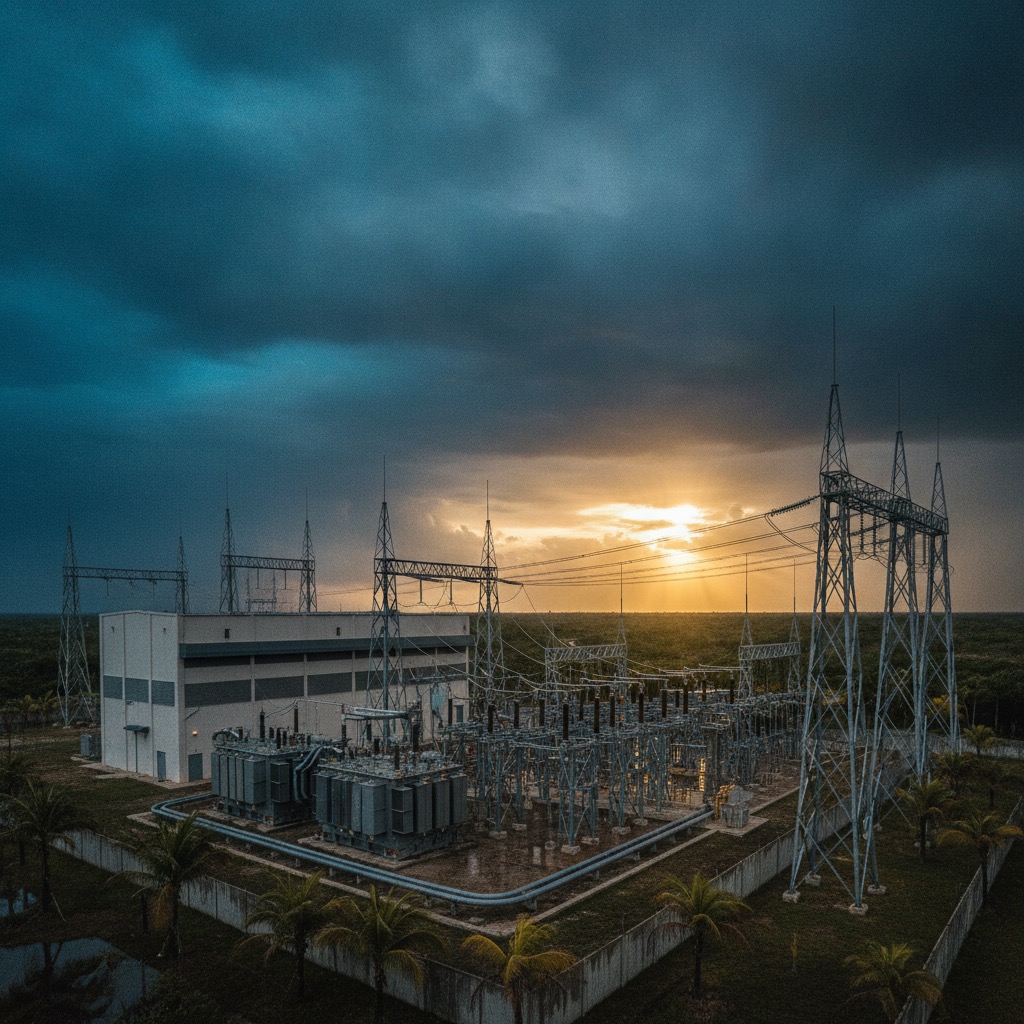
Every hurricane season, the question comes late: when there is already a forecast track cone over the peninsula and the plant discovers that its only defense is an emergency generator no one has tested in six months. Electrical resilience is not bought the week before impact; it is designed in advance, measured, and managed like any other operational risk. And for the industry betting on the southeast —nearshoring, the development hubs of the Interoceanic Corridor, the activity set off by the Maya Train— the risk of electrical continuity has stopped being a technical detail to become a business variable.
This article approaches resilience from energy management: not as a list of equipment to buy, but as an exercise in measuring the criticality of each load, prioritizing investment by return in continuity, and managing the risk with data. It includes a hierarchy of measures ordered by cost and criticality, and two checklists —pre-season and post-event— so that the decision does not depend on the urgency of the latest forecast.
Why is the southeast's electrical grid especially vulnerable?
The Yucatán Peninsula operates with a grid weakly interconnected to the rest of the National Electric System and with tight reserve margins. In May 2025 it reached a peak demand close to 2,991 MW with a reported operating reserve margin of just 10.1%, according to information from CENACE reported by regional media. With such a thin cushion, the failure of a single transmission line can drag down the entire region.
It is not theory. On September 26, 2025, a blackout left Yucatán, Campeche, and Quintana Roo without electricity: CFE attributed it to a failure in a transmission line during maintenance maneuvers, and the Secretariat of Energy reported that nine plants generating 2,174 MW were affected. Months earlier, in March 2025, another massive outage covered those same states plus Tabasco due to a failure in the natural gas supply to the area's plants. On top of that structural fragility comes the season: for 2026 CONAGUA and the National Meteorological Service forecast between 11 and 15 tropical cyclones in the Atlantic, of which 1 to 2 could be major category 4 or 5 hurricanes, in a season that runs from June 1 to November 30.
The industrial southeast cannot be treated like the rest of the country
A plant in the Bajío that loses power usually recovers it in minutes thanks to a meshed and redundant grid. On the peninsula, a major event can mean hours or days without stable supply, with access roads cut off and spare parts far away. The same backup measure has a different value depending on the site: what is optional in the center of the country can be indispensable in Mérida, Cancún, or Chetumal.
What is meant by industrial electrical resilience?
Industrial electrical resilience is a plant's ability to anticipate an interruption, sustain its critical loads during the event, and recover normal operation in the shortest possible time. It is not equivalent to having an emergency generator: it is a system of tiered measures —backup, redundancy, automatic transfer, and procedures— designed from the real criticality of each load, not from the impulse to buy the biggest generator.
The distinction matters because it changes the order of decisions. Before quoting equipment, the plant must answer three measurable questions: which loads cannot be stopped without serious damage or loss, how long they must be sustained, and how much each hour of downtime costs. Without those numbers, any investment in resilience is a shot in the dark. It is the same approach as industrial energy management: measure first, invest after. And those numbers are born from a reliable database of consumption and operation, what we call Utility Data Management.
How much does an electrical interruption cost a plant?
The cost of an hour of downtime combines several components: production not carried out, raw material or work in process that spoils, line restarts, possible equipment damage from abrupt stops, contract breaches and, in sectors such as food or pharma, food-safety risk. For a continuous-process plant, a single unplanned interruption can cost more than the backup that would have prevented it. Quantifying that loss is what turns the investment in backup into a business case with payback before the CFO, not an expense that is hard to justify.
That number —the cost per hour of unavailability of each line— is the metric that orders the entire resilience strategy. A load whose hour of downtime costs hundreds of thousands of pesos justifies robust redundancy; an administrative one, perhaps only a UPS. Quantifying it is an exercise in energy risk management: it is about investing in proportion to the loss that is avoided, not protecting everything equally.
Hierarchy of resilience measures by cost and criticality
Not all loads deserve the same level of protection, nor does every investment in resilience have the same return. The professional way to decide is to build a hierarchy: start with the cheap and cross-cutting, and scale toward the costly only for the loads that justify it by their criticality. The following table orders the measures from lowest to highest cost and indicates which load criticality each one applies to.
| Level | Measure | Relative cost | What it protects | For which criticality |
|---|---|---|---|---|
| 1 | Safe stop/start procedures and drills | Very low | Prevents damage and speeds recovery | The whole plant |
| 2 | Power quality measurement and monitoring | Low | Detects anomalies and prioritizes loads | The whole plant |
| 3 | UPS for electronic and control loads | Low-medium | Continuity of seconds to minutes | Critical control and data |
| 4 | Automatic transfer (ATS) with emergency generator | Medium | Continuity in minutes after the outage | Critical that tolerates seconds of gap |
| 5 | Battery bank / BESS | Medium-high | Instant backup and firmness of hours | Critical with no tolerance for gaps |
| 6 | N+1 redundancy in critical equipment | High | Failure of one unit without losing the function | Critical continuous process |
| 7 | Microgrid with generation and island control | Very high | Prolonged autonomous operation | Entire high-criticality site |
The logic is clear: levels 1 and 2 cost little, apply to the whole plant, and are a precondition for everything else —without measurement there is no prioritization—. Levels 5 to 7 are justified only for loads whose downtime cost backs them up. A common mistake is to jump straight to level 7 (the microgrid) without having covered levels 1 to 4, which deliver most of the resilience at a fraction of the cost.
Where battery storage fits
The BESS deserves a separate mention because it solves something the emergency generator does not: the transfer gap. A diesel generator takes seconds to start and pick up load; for processes that don't even tolerate that flicker, battery storage delivers instant backup and can sustain the load while the generator starts. In addition, outside the emergency, that same asset works every day trimming peak demand. We develop this in battery energy storage for industry.
What to protect first when the budget is limited?
First, the loads whose interruption causes irreversible damage or serious loss: people's safety, control systems, product refrigeration, and processes that are ruined by an abrupt stop. After that, the loads with a high cost per hour of downtime. Administrative loads and what tolerates hours without power go last. The order is defined by measured criticality, not by installed capacity.
This principle avoids the most expensive mistake: sizing the backup for the whole plant when only a fraction of the load is truly critical. Segmenting the loads by criticality —and backing up only what warrants it— usually reduces the investment by half or less compared to a total backup, with the same level of protection where it matters. That segmentation relies on energy KPIs that make each load measurable and comparable.
Pre-season preparation checklist
Resilience is won in the calm months, not in the week of the track cone. Before June 1, every plant in the southeast should have this checklist closed:
- Inventory of critical loads with their cost per hour of downtime documented and current.
- Full-load test of emergency generators and verification of the automatic transfer (ATS).
- Fuel levels at maximum and a priority resupply contract confirmed in writing.
- State of charge and health of UPS and BESS batteries verified, with no degraded cells.
- Maintenance of substation, switchboards, and protections up to date, with recent thermography.
- Updated safe stop and start procedure and trained personnel.
- Backup of configurations, data, and process recipes off-site.
- Contacts for CFE, spare-parts suppliers, and emergency service on hand.
Post-event response checklist
When power returns after a hurricane, the risk does not end: a poorly done restart damages equipment and triggers spikes. This checklist orders the return:
- Verify the quality of incoming power (voltage, frequency, stability) before reconnecting loads.
- Start in stages, from smaller to larger, avoiding the simultaneous startup that creates demand spikes.
- Inspect switchboards, motors, and critical equipment for moisture or damage before energizing.
- Check fuel consumption and resupply emergency generators while the grid stabilizes.
- Document the event duration, lost loads, and real cost to feed the next measurement cycle.
- Update the hierarchy of measures with the lessons learned: what failed, what was missing, what was over-invested.
How Enerlogix approaches electrical resilience
At Enerlogix we treat resilience as part of the Plan 360 Management, from energy management: we measure the criticality and the downtime cost of each load, build the hierarchy of measures tailored to your site and your budget, and design the pre-season and post-event procedures. As an independent consultancy, we don't sell generators or batteries: our only product is the recommendation that protects your continuity at the lowest cost, not the sale of equipment. We work with data from your real operation, not with catalogs.
Request a free evaluation or learn about our energy management service. Every plant is different, but the method —measure, prioritize, manage— repeats.
Frequently asked questions
It is a plant's ability to anticipate an interruption, sustain its critical loads during the event, and recover normal operation in the shortest possible time. It is not equivalent to having an emergency generator: it is a tiered system of backup, redundancy, automatic transfer, and procedures, designed from the real criticality of each load and from how much each hour of downtime costs.
Because the Yucatán Peninsula operates with a grid weakly interconnected to the rest of the National Electric System and tight reserve margins, close to ten percent at peak demand. With such a thin cushion, the failure of a single transmission line can leave several states without power, as happened in the blackouts of March and September 2025.
First the loads whose interruption causes irreversible damage or serious loss: people's safety, control systems, product refrigeration, and processes that are ruined by an abrupt stop. After that the ones with the highest cost per hour of downtime. Administrative loads go last. The order is defined by the measured criticality of each load, not by its installed capacity.
The UPS gives continuity of seconds to minutes for electronics and control. The emergency generator with automatic transfer sustains the load for hours, but takes seconds to start. The BESS or battery bank covers that gap with instant backup and, outside the emergency, trims peak demand every day. They are usually combined according to each load's tolerance for the transfer gap.
Before the official start of the season, on June 1, not the week before impact. Resilience is won in the calm months: testing emergency generators with real load, verifying the automatic transfer, checking batteries, securing fuel and maintenance, and having the safe stop and start procedures ready. Arriving at the track cone without this is betting on luck.


