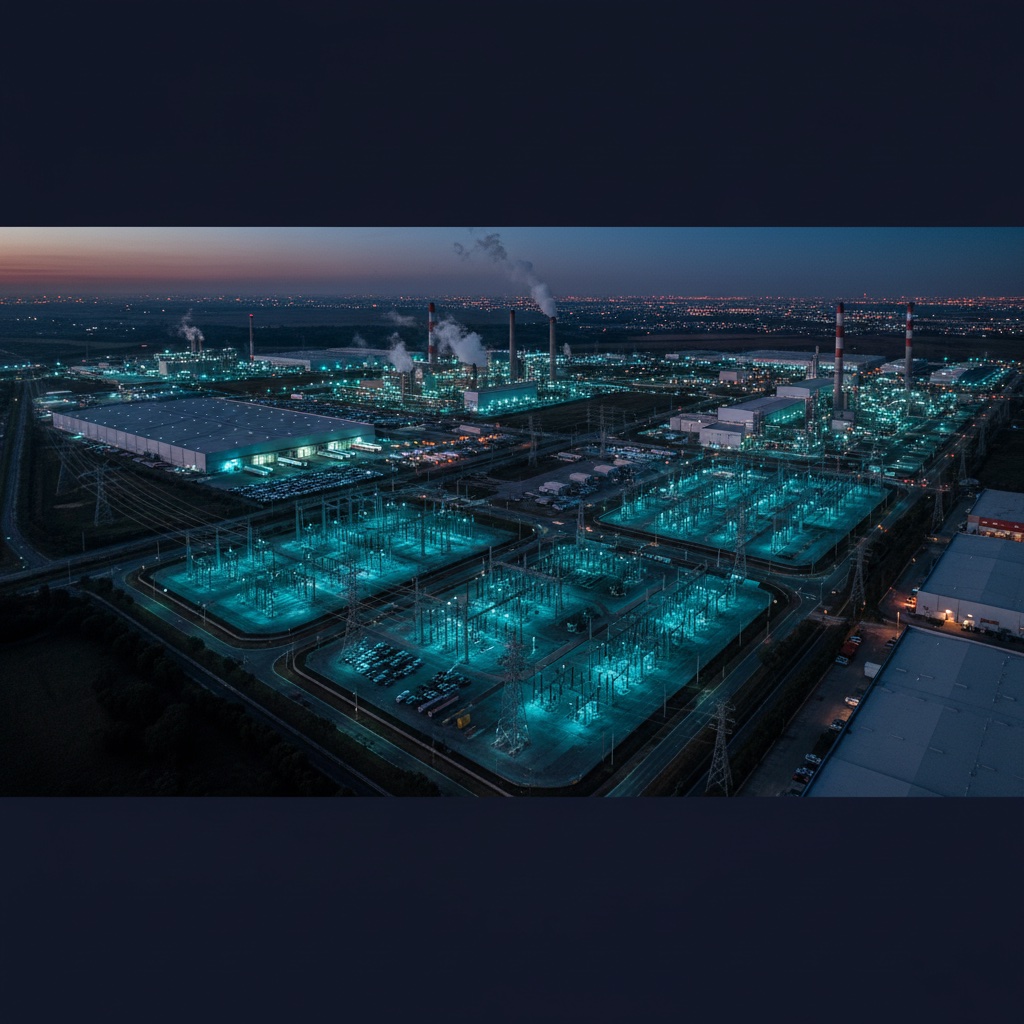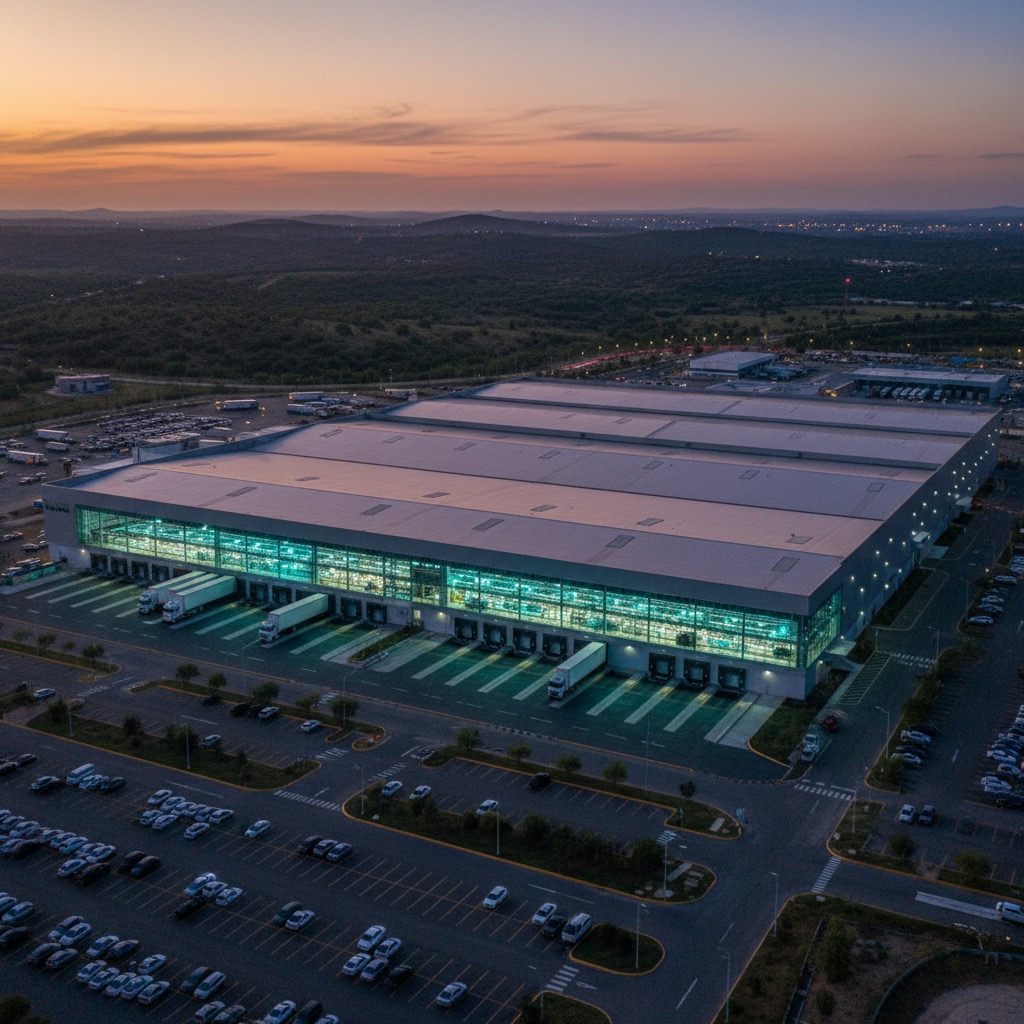
This is a composite case based on real patterns handled by Enerlogix in the Saltillo–Ramos Arizpe automotive corridor between 2024 and 2026. Some operational details have been modified to preserve confidentiality, but the figures, phases, and lessons reflect real engagements with tier-1 plants in the automotive industry.
The context
A tier-1 automotive plant in Saltillo, dedicated to stamping and welding of car bodies for a Japanese OEM, operates with 5.8 MW of contracted demand in medium voltage at 23 kV. Three continuous shifts, 6.5 days a week, with a scheduled 18-hour shutdown each month.
The company had grown organically since 2018: new stamping lines, a 1.8 MW expansion in 2022, installation of variable frequency drives on the paint line in 2024. The entire expansion was carried out with individual CFE authorizations but without updating the Grid Code electrical studies.
The trigger
In October 2024, the CRE conducted a scheduled inspection visit. Result: a findings notice with 6 non-conformities:
- Outdated short-circuit and protection coordination studies (valid but predating the 2022 expansion)
- No formal power quality study despite the number of installed drives
- Protection coordination not operationally verified
- Annual technical reports not submitted since 2022
- Grounding system without recent resistivity measurement
- Maintenance documentation scattered across multiple folders
The CRE granted an initial 6-month term to submit a remediation plan. Estimated potential penalty: MX$3.2M – MX$5.8M if the company failed to respond adequately.
The intervention · Plan 360 Management
The plant contacted Enerlogix in November 2024. After a free initial evaluation, a 14-month plan was defined, divided into the 4 standard phases of the Grid Code compliance plan, with specific adjustments for the situation.
Phase 1 · Diagnosis (November 2024 – December 2024)
- Full documentary audit of 14 years of operation
- Physical verification of 23 critical electrical nodes
- Mapping of current and projected loads at 18 months (including a planned 0.6 MW expansion in 2025)
- Identification of specific gaps for each CRE finding
- Inventory of 4 main transformers and 18 power protection devices
Unexpected critical finding: two relays on the stamping line had factory settings never modified since 2018, even though the theoretical studies assumed specific settings.
Phase cost: MX$190,000.
Phase 2 · Electrical studies (January 2025 – May 2025)
Executed in this order:
- Month 1: short-circuit + protection coordination (in parallel)
- Month 2: load flows
- Month 2–3: power quality measurement campaign (28 continuous days, Class A analyzer)
- Month 4: grounding and earthing system
- Month 5: integration of the technical file
Study results:
- Current THD: 17.8% on main busbars (12% limit at that voltage level), a power quality issue with harmonics and flicker. Cause: paint-line drives installed in 2024 without filters.
- Flicker Pst: 1.4 during stamping press operation (1.0 limit).
- Protection coordination: 3 relays with inadequate settings causing a risk of non-selective tripping on a fault in the secondary feeder.
- Grounding system: resistance of 8.2 Ω (acceptable, within the IEEE 80 limit for that size).
Phase cost: MX$920,000 (includes fees, analyzer rental, field measurements).
Phase 3 · Implementation (June 2025 – December 2025)
The corrections were planned to take advantage of the monthly 18-hour shutdowns and an extended 4-day shutdown in July:
June 2025: readjustment of the 3 poorly coordinated relays during a monthly shutdown. Verification tests. Cost: MX$85,000.
July 2025 (extended 4-day shutdown):
- Installation of 2 passive filters tuned to the 5th and 7th harmonic on the paint-line busbars
- Addition of a capacitor bank corrected for power factor + harmonics
- Reorganization of single-phase loads to balance the detected imbalance
- Comprehensive electrical testing post-modification
- Cost: MX$1,820,000
September 2025: installation of permanent power quality monitoring at the service entrance and main busbars. Three Schneider PM5560 analyzers. Cost: MX$245,000.
November 2025: final verification tests. New power quality measurement over 14 days. Results:
- Current THD: 9.2% (below the 12% limit)
- Flicker Pst: 0.78 (below the 1.0 limit)
- Protection coordination validated against 4 simulated fault scenarios
Phase 3 total: MX$2,150,000.
Phase 4 · Steady state (January 2026 – March 2026)
- Integration of the complete file (studies + corrections + verifications)
- Formal submission to the CRE in February 2026
- Training of the internal maintenance team on use of permanent monitoring
- Definition of monthly compliance KPIs
- Schedule of annual reports and preventive maintenance over 24 months
Phase cost: MX$210,000.
Results at close · March 2026
Regulatory results
- 6 of 6 findings closed with the CRE
- Penalty avoided: estimate of MX$3.2M – MX$5.8M
- Actual penalty applied: zero (warning without fine, for demonstrated cooperation)
- Term until next scheduled audit: 36 months
Collateral operational results
- 38% reduction in unscheduled tripping events in the first operating quarter post-corrections
- 22% reduction in low power factor penalty (the filters helped correct PF)
- Estimated useful life of main transformers extended 2–3 years due to harmonic reduction
- Production line availability: +1.3% monthly (fewer electrical shutdowns)
Financial results
| Item | Amount (MXN) |
|---|---|
| Total Plan 360 Management investment | $3,470,000 |
| CRE penalty avoided | ~$4,500,000 (mid-range) |
| Annual savings on power factor penalty | $180,000 |
| Annual savings from fewer operational shutdowns | ~$680,000 |
| Estimated project payback | 18 months |
Lessons from the case
1. The gap between what the engineer signs off and what is in operation
Relays with factory settings never modified are surprisingly common. Plants assume the old studies describe the operational reality, but the operator from year X readjusted something and nobody documented it. Physical verification after the study was critical — and it is exactly what a preventive substation maintenance program with periodic injection testing of relays prevents.
2. Coordinate the corrections with scheduled shutdowns
Concentrating the most invasive interventions in the extended July shutdown saved ~MX$600,000 in lost production compared to doing them in individual monthly shutdowns.
3. Harmonic filters are a dual-purpose investment
The MX$1.5M in filters simultaneously corrected power quality (Grid Code) and power factor (CFE penalty). The filter's payback against the penalty alone is ~7 years, but against Grid Code + penalty + transformer useful life it drops to 2.5 years.
4. Cooperation with the CRE mitigates the penalty
The company submitted a remediation plan within the first 30 days after the notice and maintained open communication with the authority throughout the 14 months. Result: the actual penalty was zero pesos, only a warning.
5. Permanent monitoring as a preventive investment
The MX$245,000 for permanent monitoring is not a Grid Code obligation, but it allows drift to be detected before it escalates. The plant no longer depends on one-off campaigns — it has daily data.
Is your plant in a similar situation?
If your industrial plant has open findings with the CRE, recent expansions without updated studies, or drives and non-linear loads added in the last 3 years without power quality measurement, you are probably in a scenario comparable to this case.
At Enerlogix we have executed Plan 360 Management —which includes our Grid Code compliance service— with more than 50 industrial companies — automotive, food, chemical, cement, electronics manufacturing — with similar results. Each case is different, but the patterns repeat.
Request a free Plan 360 Management evaluation. Within 10 business days we deliver a diagnosis of your current situation, a gap map, and a realistic schedule to reach stable compliance.
To understand the full framework, read the Grid Code 2026 pillar — Complete Guide, CRE penalties for non-compliance, and Grid Code compliance plan: an 18-month schedule.
Frequently asked questions
In this case the tier-1 plant in Saltillo, with 5.8 MW of contracted demand, closed its 6 findings in 14 months with Plan 360 Management, divided into four phases: diagnosis, electrical studies, implementation, and steady state. The actual timeline depends on the number of non-conformities and on coordinating the corrections with the plant's scheduled shutdowns.
The total Plan 360 Management investment in this case was 3,470,000 MXN, split across diagnosis (190,000), electrical studies (920,000), implementation (2,150,000), and steady state (210,000). The estimated payback was 18 months, considering the avoided penalty of around 4,500,000 MXN and the collateral operational savings.
In this case the estimated potential penalty was 3.2 to 5.8 million MXN for the 6 non-conformities. However, the plant submitted its remediation plan within the first 30 days after the notice and maintained open communication with the authority throughout the 14 months; the result was a warning without a fine, that is, an actual penalty of zero pesos for demonstrated cooperation.
Yes, they are a dual-purpose investment. In this case the passive filters tuned to the 5th and 7th harmonic simultaneously corrected the power quality required by the Grid Code and the power factor penalized by CFE. The payback of a filter against the penalty alone is around 7 years, but against Grid Code plus penalty plus transformer useful life it drops to about 2.5 years.
Yes, although it is not a Grid Code obligation in every case. In this case the three Schneider PM5560 analyzers installed at the service entrance and busbars cost 245,000 MXN and allow drift to be detected before it escalates, without depending on one-off campaigns. The plant moved to having daily data and evidence available for the CRE in case of a finding.