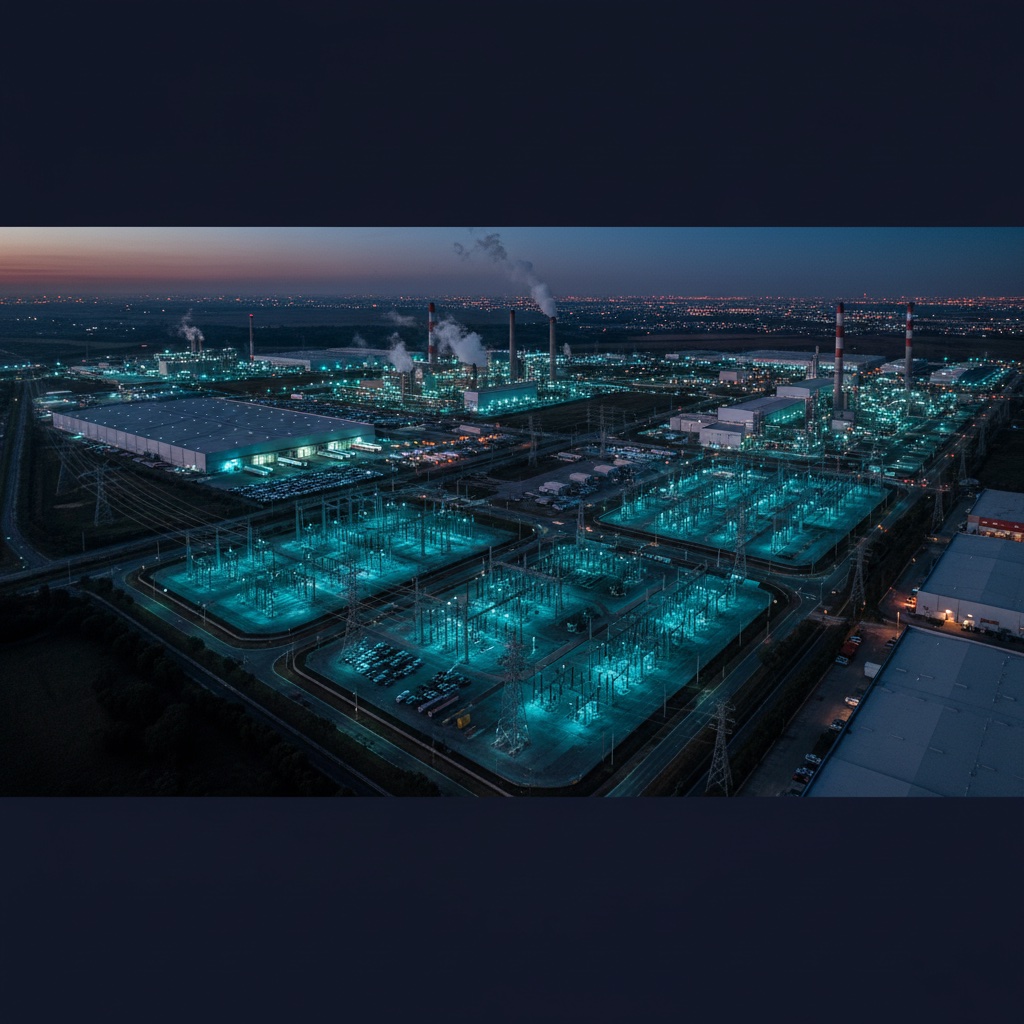
When a plant decides to produce part of its own energy, the first reflex is usually to request a quote for rooftop solar panels. It is a valid option, but not the only one nor always the best. The underlying question is not "do I install solar or not?", but "which self-supply model fits my demand, my available capex, and how much control do I want over the asset?". Broadly, there are two paths: distributed generation on the site itself and utility-scale generation —a large dedicated plant or a PPA with a third party— that participates in the market. Each one completely changes the profile of investment, permits, and risk.
This article compares both models with criteria an industrial buyer can weigh, and closes with a decision matrix by demand range. If you are still evaluating whether to migrate to the market, it is best to first read the industrial energy optimization guide; here we assume you already want to generate and only need to decide how.
What is distributed generation and where is the threshold?
Distributed generation is energy produced at the site of consumption or very close to it, normally rooftop solar or in-house cogeneration, sized for self-consumption. Its key regulatory feature is the capacity threshold: below a certain size, the plant is an exempt generator and does not need a generation permit.
The capacity threshold in Mexico
Under the 2014 Electricity Industry Law, that limit was set at 0.5 MW. With the Electricity Sector Law published in 2025, the threshold to operate as distributed generation without a permit from the authority rose to 0.7 MW, and the regulator was renamed the National Energy Commission (formerly CRE), according to the law firm Holland and Knight. Below that cap, the process is one of interconnection, not a generation permit.
What happens above the threshold
A self-consumption plant between 0.7 MW and 20 MW does require a generation permit, but it can be subject to a simplified process from the National Energy Commission, in accordance with the agreement published in the Official Gazette. Above 20 MW, or if the plant is represented in the market, you fully enter the Wholesale Electricity Market (MEM): a full permit and dispatch coordinated by CENACE according to the variable cost of each unit. At that point we are talking about utility-scale generation, not distributed generation.
How do distributed generation and a utility-scale plant differ?
Distributed generation lives behind your meter, avoids transmission losses, and is operated to cover your load. Utility-scale generation lives on the market side: large capacity, higher capex, full permits, and dispatch by CENACE. One optimizes self-consumption close to the point of use; the other seeks volume and commercialization in the MEM.
That difference in location has practical consequences on six fronts that matter for an investment decision.
Comparison table: distributed vs utility-scale
| Criterion | Distributed generation (on-site, up to the threshold) | Utility-scale plant / PPA (MEM) |
|---|---|---|
| Capex | Lower; modular, scalable in stages | High; requires project finance or a partner |
| Permits | Interconnection only below the threshold; simplified up to 20 MW | Full generation permit; registration in the MEM |
| Asset control | Total if owned; you decide operation and maintenance | Shared or none if it is a PPA with a third party |
| Scale | Limited to the threshold or to your roof or land | Tens of MW; no practical size cap |
| Transmission losses | Minimal; generated where it is consumed | Transport losses apply across the grid |
| Resilience | High against grid failures; local backup | Depends on the SEN and CENACE dispatch |
The table reveals the pattern: distributed generation wins on simplicity, speed of implementation, and local resilience; the utility-scale plant wins on the unit cost of energy when the volume is very large, in exchange for regulatory and financial complexity.
When does each model make sense by plant size?
As a reference, a plant with low-to-medium demand and available roof space usually gets a better return from distributed solar generation. One with high demand, a continuous thermal process, or the ambition to cover a large share of its consumption starts to justify a utility-scale plant or a PPA. The breaking point depends on capex and regulatory appetite.
Decision matrix by demand range
| Demand range | Natural model | Why |
|---|---|---|
| Less than 0.7 MW | Distributed generation (solar or small cogeneration) | Fits as an exempt generator; interconnection only, low capex |
| 0.7 to 5 MW | Distributed with simplified permit, or a mix with PPA | Still fits on-site; the simplified process opens the door to more capacity |
| 5 to 20 MW | Owned plant with permit, or physical PPA | The volume justifies higher capex; weigh control vs project finance |
| Greater than 20 MW | Utility-scale plant or PPA in the MEM | Full permit and market participation; economies of scale dominate |
These ranges are indicative, not a rigid rule. A 4 MW plant with little roof space and zero capex appetite may prefer a PPA, while another at 1.5 MW with available land and its own cash does better business generating on-site. The correct exercise is to model your real load curve against each scenario.
Solar, cogeneration, or batteries? The asset within the model
Choosing the model does not exhaust the decision: within distributed generation you have to choose the technology, and they are often combined.
Photovoltaic solar
It is the most common entry point to distributed generation: modular capex, no fuel, and a predictable payback where there is good solar resource and roof or land. Its limit is that it only generates during the day, so it rarely covers 100% of a continuous operation on its own. We analyze the business case in depth in industrial solar: when it makes sense.
Cogeneration
For plants with simultaneous demand for electricity and heat or steam —food, chemicals, paper— cogeneration with natural gas takes advantage of the residual heat and raises overall efficiency well above buying electricity and generating steam separately. It is the self-supply model with the highest plant factor for a continuous process, as we detail in cogeneration with natural gas in the food industry.
Storage
Batteries do not generate energy, but they boost any distributed model: they store the solar surplus for nighttime use, flatten peak demand, and provide backup against grid failures. It is the piece that turns distributed generation into something close to autonomy. We cover it in energy storage with batteries in industry.
How important is regulatory appetite in the decision?
Very. Distributed generation below the threshold only requires interconnection, so it is implemented quickly and with little administrative burden. Entering the MEM with a utility-scale plant implies a full permit, registration as a market participant, and exposure to CENACE dispatch. If your organization does not want that file, the distributed model avoids it.
That is why "regulatory appetite" is a decision criterion as real as capex. A company with a mature energy team and a long horizon absorbs the complexity of the MEM in exchange for better economics at large volume. One without that structure prioritizes distributed generation precisely because it keeps the decision technical and leaves the heavy regulatory burden out.
How Enerlogix defines the right model for your plant
At Enerlogix we don't start from a favorite technology: we start from your bill and your load curve. We model each scenario —distributed solar, cogeneration, an owned plant, a PPA— against your real demand, your available capex, and your regulatory tolerance, and we deliver the comparison in pesos and in years of payback, not in brochures. As an independent consultancy under the Plan 360 Management, our only product is the right recommendation, not the sale of a piece of equipment.
Request a free evaluation or learn about the energy optimization service. We work with your real consumption and the regulatory ranges in force.
Frequently asked questions
Under the 2014 Electricity Industry Law the limit to operate as an exempt generator without a permit was 0.5 MW. With the 2025 Electricity Sector Law that threshold rose to 0.7 MW, according to law firms such as Holland and Knight. Below that cap the process is interconnection only, not a generation permit.
A self-consumption plant between 0.7 MW and 20 MW requires a generation permit, but it can be subject to a simplified process from the National Energy Commission. Above 20 MW, or if the plant is represented in the market, you enter the Wholesale Electricity Market with a full permit and dispatch coordinated by CENACE.
It depends on plant size and capex appetite. Distributed generation wins on low capex, speed, and local resilience for demands below a few MW. A utility-scale plant or a PPA in the MEM wins on unit cost when the volume is very large, in exchange for full permits and greater financial and regulatory complexity.
Yes. Because the energy is produced at the site of consumption or very close to it, distributed generation avoids transport across the transmission grid and minimizes the associated technical losses. Utility-scale generation, by contrast, injects into the system and the energy travels long distances, so transport losses apply until it reaches the point of consumption.
Not necessarily. If your plant stays below the distributed generation threshold, the interconnection process is enough and you operate as an exempt generator without entering the Wholesale Electricity Market. Only when you exceed 20 MW, or decide to represent your plant in the market, do you participate in the MEM under CENACE dispatch.