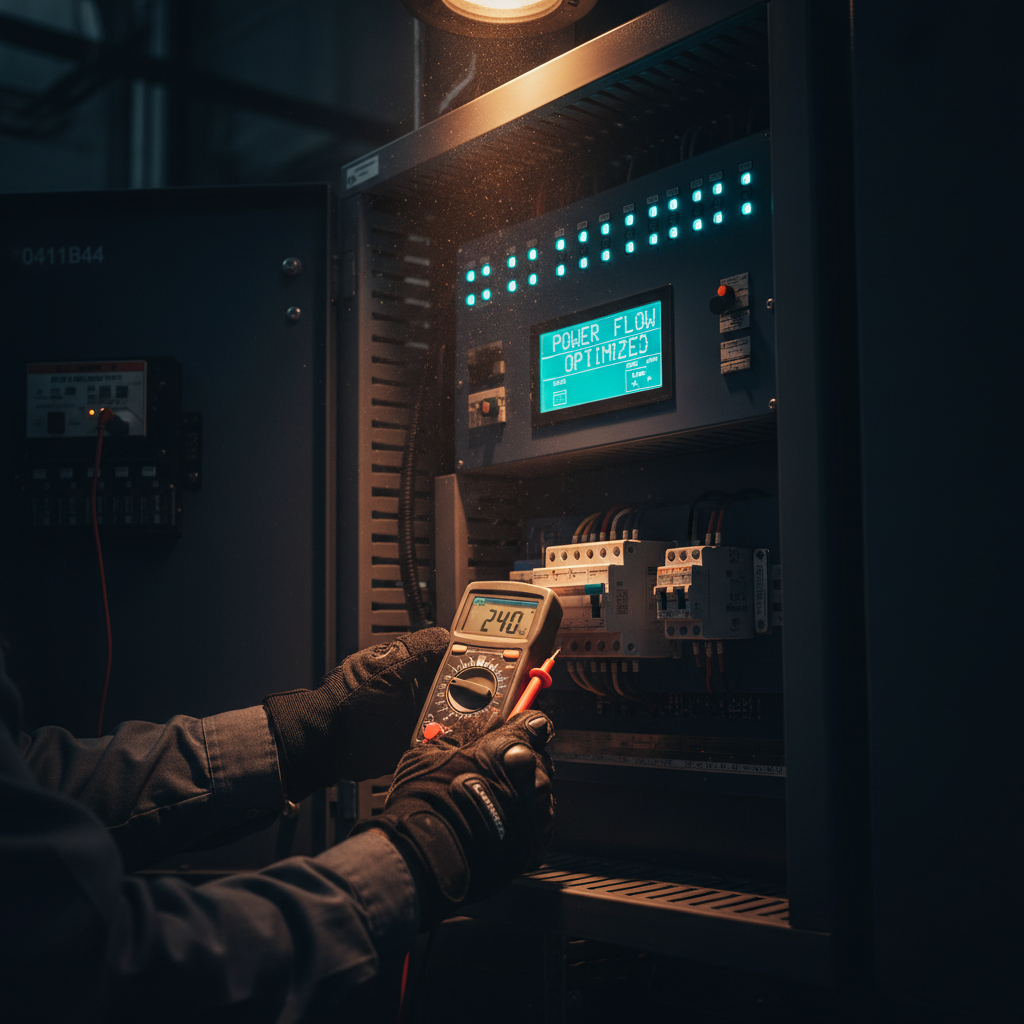
One of the best plants we audited in recent years belonged to an industrial group whose maintenance director was convinced he needed to replace 12 electric motors with IE4 units. The projected investment exceeded 8 million pesos. The audit —three weeks of serious work— showed a different reality: four of those motors barely operated 600 hours a year, their payback as IE4 was over 12 years, and the real waste was concentrated in the compressed-air system and in power factor. The optimized investment ended up at 1.4 million pesos, with an 11-month payback.
That gap between what plants believe they need and what truly makes sense is the reason an energy audit is not optional. Without a rigorously measured baseline, every subsequent investment is a gamble. This article develops what to measure, how to do it, and what deliverables to demand from a serious auditor.
What an energy audit is and what it is really for
An industrial energy audit is the systematic process of building a plant's consumption profile, identifying where and how energy is consumed, quantifying waste, and constructing a prioritized portfolio of measures with estimated returns.
It is not a one-day visit nor an Excel file with benchmarks. It is structured field, engineering, and financial analysis work that produces three concrete outputs:
- Verifiable baseline — the reference point against which future savings will be measured.
- Consumer map — which equipment, processes, or areas consume what percentage of the total.
- Measure matrix — list of opportunities with estimated savings, investment, payback, and prerequisites.
Without those three deliverables, any "30% savings" speech is marketing, not engineering.
Audit levels: which one you need
There are three usual levels of energy audit. Knowing which one you need prevents overpaying or coming up short.
Level 1 — Walkthrough
A 1- to 3-day visit with last-bills analysis and a plant tour. Identifies obvious opportunities and produces a preliminary report. Useful as an initial diagnostic to decide whether deeper work is worthwhile. Low cost, limited depth.
Level 2 — Detailed analysis
3 to 8 weeks of work with point measurements (portable energy analyzers), 12-month billing analysis, modeling of main loads, and a quantified measure matrix. It is the appropriate level for most mid-sized Mexican industrial plants. Balanced depth and cost; delivers actionable value.
Level 3 — Investment-grade engineering
Detailed study of specific measures with preliminary engineering, quotations, project-level financial modeling, and technical specification. Usually chained after a Level 2 for measures that pass the investment filter. High depth, proportional cost, justifiable when significant capex is at stake.
A practical recommendation: if you have never done an energy audit, start at Level 2. Level 1 frequently underdiagnoses, and Level 3 without prior Level 2 focuses detail in the wrong places.
Data you must gather before measuring
The audit starts with historical data. Without it, point measurements lose context.
Last 12 months of billing. Full bills —not totals—. You need to see breakdown by tariff, contracted demand, measured peak demand, consumption in peak/intermediate/base hours, power factor, penalty charges. If your RPU is under CFE Basic Supply, the bills contain almost everything needed to diagnose the contractual lever.
Hourly load profile. If you have a smart meter capable of exporting the hourly curve, download it. CENACE outputs are at 5-minute intervals for MEM participants. Without this data, the auditor must install temporary analyzers for at least 2 weeks at key points.
List of main equipment and operating hours. Motors with power, nominal efficiency, installation year, annual hours, load regime. Compressors, boilers, ovens, chillers, AHUs. Without this list, the measure matrix becomes generic.
Single-line diagram and electrical calculation memo. To map measurement points and understand the electrical topology.
Production data. Tons, pieces, or meters produced per month. Without production, there is no specific consumption (kWh per unit), and without specific consumption, there is no honest way to measure improvements.
Mapping the major consumers: the 80/20 rule
In most Mexican industrial plants, 80% of electricity consumption is concentrated in less than 20% of the equipment. Identifying that 20% is the audit's priority.
Typically dominant consumers:
- Electric motors — pumps, fans, compressors, conveyors. Frequently 40% to 70% of consumption.
- HVAC and refrigeration — chillers, cooling towers, AHUs. From 10% to 25% in plants with cleanrooms or thermal processes.
- Lighting — 5% to 15% in conventional plants; less in modern plants.
- Compressed air — 5% to 25%, with leak waste typically reaching 20% to 40% of system consumption.
- Furnaces and electrical thermal processes — variable by industry; in metallurgy or glass it can be dominant.
The auditor must deliver a Pareto diagram with the percentage of consumption per equipment family. If that diagram does not appear in the report, the scope was weak.
Critical measurements the audit must include
Beyond document analysis, there are measurements obtainable only in the field:
- Power factor per main circuit and total — Identifies opportunities for capacitor-bank compensation. For more detail, Power Factor: Why CFE Penalizes You.
- Demand curve at 15-minute resolution — Reveals peaks, valleys, ghost consumption outside shifts, and peak demand management opportunities.
- Surface temperature of steam pipes, furnaces, and insulation — Thermal losses with thermographic camera. Frequently reveals insulation opportunities with payback under 18 months.
- Pressures and flows in compressed air — To detect over-pressurization and quantify leaks.
- Power quality — Harmonics, distortion, sags. Important in plants with VFDs, welders, or non-linear loads.
- Operational efficiency of main motors — Comparison of real vs nominal load. Oversized motors operating at 30% load are candidates for adjustment.
Expected output: measure matrix with ROI
The flagship deliverable of a serious audit is the measure matrix. Each row must include:
- Measure description
- Estimated annual savings (kWh and MXN)
- Estimated investment (with uncertainty range)
- Simple payback (months or years)
- Technical prerequisites and dependencies
- Operational risks
- Production impact during implementation
Measures are typically sorted by ascending payback and grouped in three waves: quick wins (payback under 6 months), light-capital measures (6 to 24 months), and structural measures (over 24 months).
To go deeper into which measures have the best documented ROI in Mexican industry, read Top 10 Energy Efficiency Measures with Best ROI.
Who runs a good audit: auditor profile
Not everyone calling themselves an "energy auditor" in Mexico operates at the same level. What is worth demanding:
- Team with electrical and mechanical engineers, not just commercial staff
- Documented experience in plants similar to yours (sector and intensity)
- Own measurement equipment (certified analyzers, thermography, ultrasonic)
- Commercial independence — an auditor who also wants to sell you the recommended equipment has conflict of interest
- Auditable deliverables — explicit reference to ISO 50002 or ASHRAE Levels 1-2-3 methodologies
- Measurement-and-verification (M&V) capability post-implementation
Common errors that invalidate audits
After reviewing dozens of third-party audits, the costliest error patterns:
- Reporting savings without verifiable baseline — turns any debate about results into opinion.
- Recommending equipment without measuring its actual operating regime — the case of the director with the 12 IE4 motors that didn't qualify.
- Ignoring the contractual lever — audits that look only at consumption leave out the largest opportunity for MEM-eligible companies.
- Not measuring power factor or peak demand — these are first-return levers and frequently fall outside scope.
- Presenting simple payback without sensitivity — a payback assuming stable tariff and constant operating hours is fragile.
Next step
The audit is the first step of a broader methodology we articulate in the Strategic Guide to Industrial Energy Optimization and continued by defining tracking KPIs and prioritizing concrete measures. To understand the base language —what optimization vs efficiency really mean— see What is Industrial Energy Optimization?.
If you want a Level 2 energy audit with verifiable deliverables —measure matrix, ROI per measure, implementation plan—, request a proposal. We work with Mexican industrial plants with contracted demand at or above 250 kW.
Frequently asked questions
There are three levels. Level 1, or walkthrough, is a 1- to 3-day tour with bill analysis, useful as an initial diagnostic but limited in depth. Level 2 is a detailed 3- to 8-week analysis with point measurements and a quantified measure matrix; it is the right one for most mid-sized Mexican plants. Level 3 is investment-grade engineering for specific measures. If you have never audited, start with Level 2.
Three concrete outputs: a verifiable baseline as the reference point to measure future savings; a consumer map showing which equipment or processes consume what percentage of the total, ideally with a Pareto diagram; and a measure matrix with estimated savings in kWh and pesos, investment, payback and prerequisites. Without those three deliverables, any savings promise is marketing, not engineering.
Full billing for the last 12 months broken down by tariff, demand and power factor; the hourly load profile if you have a smart meter; the list of main equipment with power, efficiency and operating hours; the single-line diagram; and production data in tons, pieces or meters. Without production there is no specific consumption per unit, and without it there is no honest way to measure improvements.
Because in most Mexican industrial plants 80% of electricity consumption is concentrated in less than 20% of the equipment. The dominant consumers are usually electric motors, often between 40 and 70% of consumption, followed by HVAC and refrigeration, lighting, compressed air and furnaces. In compressed air, leaks can reach 20 to 40% of the system's consumption.
A team with electrical and mechanical engineers, not just commercial staff; documented experience in plants of your sector and intensity; its own measurement equipment such as certified analyzers, thermography and ultrasonic gear; commercial independence, since an auditor who also sells you the recommended equipment has a conflict of interest; auditable deliverables referencing ISO 50002 or ASHRAE methodologies; and the capacity to measure and verify results after implementation.