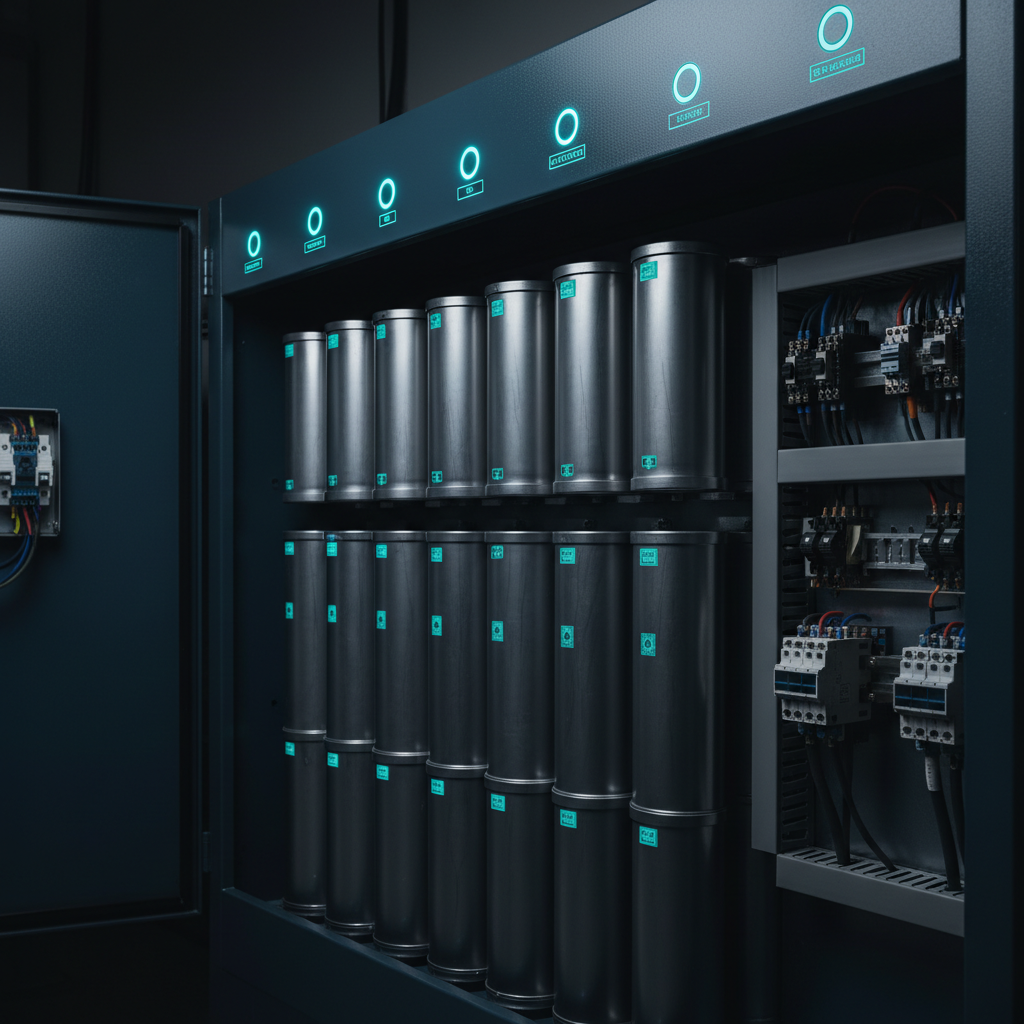
There is a charge on CFE industrial bills that appears, month after month, with a discreet asterisk and a figure rarely anyone discusses. It is called "power factor bonus or charge," and for many Mexican industrial plants it represents 2% to 8% of the total bill. The remarkable fact is that it is among the most recoverable charges: by installing a properly specified capacitor bank, the penalty disappears in weeks, and the investment typically pays back in 6 to 18 months.
Despite that, we find plants paying this charge for years. The cause is rarely technical ignorance from the maintenance lead; it is usually a lack of visibility on how much it costs and a lack of judgment on how to size the solution. This article develops what power factor is, how it translates into a CFE penalty, and what to demand when installing the correction.
What power factor is in 90 seconds
The power factor measures how efficiently your plant uses the electricity received from the grid. It is the ratio between active power (kW, the kind that actually does work) and apparent power (kVA, the kind the grid must deliver).
The classic analogy: imagine ordering a beer mug. The useful liquid beer is active power. The foam on top —present but worthless— is reactive power. The sum is apparent power. If your mug has lots of foam, the grid has to deliver more kVA so you actually get the kW you really need. That inefficiency has a cost, and CFE charges for it.
Loads generating much "foam" (reactive power) are typical in industry: induction motors, transformers, welders, old ballasts, induction furnaces. Plants with many large motors and inattentive maintenance to power factor often operate below 0.85.
The CFE penalty formula
CFE applies a charge or bonus according to the measured power factor during the month. The general structure (verifiable on your DAC or on the CFE portal):
-
Power factor of 0.90 or higher — no charge. If it is above 0.90, there is even a small bonus that grows as it approaches 1.
-
Power factor below 0.90 — percentage penalty applied to the bill amount, calculated with the formula:
Charge = (3/5) × ((0.90 / PF) - 1) × Billable amount
In practical terms:
- Power factor of 0.85 — penalty roughly 3.5% on the bill
- Power factor of 0.80 — penalty roughly 7.5%
- Power factor of 0.75 — penalty roughly 12%
- Power factor of 0.70 — penalty roughly 17%
For a plant with a monthly bill of MXN 1 million and power factor of 0.80, the monthly penalty is approximately MXN 75,000 —MXN 900,000 a year, recurring—. Any properly specified capacitor bank pays that off in less than a year.
Why your industry probably has low PF
Dominant loads in a typical plant are inductive, and each lowers power factor:
- Induction motors — most operating between 0.75 and 0.85 at full load; even lower when partially loaded.
- Transformers under no-load or partial load — can operate with very low power factor in low-production hours.
- Arc and resistance welders — generate relevant reactive demand.
- Induction and arc furnaces — non-linear loads with variable power factor and harmonics.
- Old magnetic ballasts — in legacy lighting still present.
- Pumps and fans with oversized motors — operate at low relative load, worsening natural power factor.
The older or more diverse the plant, the more likely the aggregate power factor is low. The energy audit must measure it —see Energy Audit: What to Measure and Why—.
How to measure it on your current bill
Your CFE bill explicitly shows the monthly power factor. What to look for:
- "Power factor" section — usually in the middle or lower part of the bill. Appears as a decimal value between 0.50 and 1.00.
- "Power factor bonus or charge" line — next to the amount. If positive (charge), your factor is below 0.90; if negative (bonus), it is above.
- History of the last 12 months — if your factor varies between 0.78 and 0.86 over the year, the average determines how much you are paying.
For industry under GDMTO, GDMTH, or equivalent tariffs, calculating how much you are leaving go is straightforward: sum the last 12 months of power factor charges. If the annual figure exceeds MXN 100,000, there is a clear business case to correct it.
Solutions: fixed vs automatic capacitor banks
Once the opportunity is identified, there are three main technical solutions:
Fixed capacitor banks
Capacitors permanently connected. Useful when reactive demand is stable and predictable —typically plants with large motors operating continuously—.
Advantage: low cost, simple installation. Disadvantage: if reactive load varies a lot, fixed capacitors can overcompensate in low-load hours (capacitive power factor, also penalized).
Automatic capacitor banks
Banks with multiple steps that connect/disconnect according to reactive demand measured in real time. Useful for plants with variable production, alternating loads, or diverse shifts.
Advantage: maintain optimal power factor regardless of load. Disadvantage: higher cost, more careful maintenance required.
Harmonic filters with compensation
In plants with non-linear loads (drives, arc furnaces, welders), simply installing capacitors can create resonance with harmonics and damage equipment. In those cases, passive or active filters compensating power factor while filtering harmonics are needed.
When to use them: if the audit detects significant harmonic distortion (THD above 8% on voltage or above 15% on current).
Typical investment and payback
Current investment ranges in Mexican industrial plants (indicative 2025-2026 prices):
- Simple fixed bank for 100 to 300 kVAR — between MXN 80,000 and 200,000 installed
- Automatic bank for 300 to 800 kVAR — between MXN 250,000 and 600,000 installed
- Active filters with compensation, plants with harmonics — between MXN 700,000 and 2 million
Typical paybacks in Mexican plants with real penalties: 6 to 18 months. It is one of the investments with the best documented ROI in industry, alongside compressed-air leak reduction.
Who installs correctly and what to demand from the supplier
Not every electrician can correctly size a capacitor bank. Worth demanding:
- Prior power-quality analysis —measurement of harmonics, power factor per circuit, reactive demand profile—. Without this, sizing is blind.
- Detailed bank specification —kVAR per step, capacitor type (self-regenerating or not), protection level (expected harmonics)—.
- Result guarantee —explicit commitment to bring power factor above 0.95 measured in CFE billing—.
- Maintenance plan —capacitors age, and automatic banks require contactor checks—.
- Commercial independence —ideal that the supplier is not the one designing the energy audit—.
Subsequent maintenance and continuous monitoring
A capacitor bank is not "install and forget." The most common problems in subsequent years:
- Degraded capacitors —they lose capacitance over time; a 5-year-old bank may have lost 10% to 20% of capacity—.
- Burned contactors in automatic banks —every connection and disconnection wears the contacts—.
- Capacitive overcompensation —if the plant changed its load profile, the bank may now generate penalized capacitive factor—.
- Harmonic resonance —if the plant added drives or non-linear loads, the bank may resonate—.
A reasonable protocol: annual capacity review, semi-annual contactor review on automatic banks, and review of power factor on each monthly bill. If power factor dropped from 0.95, there is pending diagnosis.
How it fits with other optimization measures
Power factor compensation is one of the best-ROI measures, but it is only one piece of the technical lever. To understand the full portfolio, read Top 10 Energy Efficiency Measures with Best ROI. If your plant also has peak demand problems, Peak Demand: How to Control It is complementary. And if you are a consumer with demand at or above 1 MW, remember Grid Code (Código de Red) compliance has specific power-factor requirements.
To understand the full optimization framework, the Strategic Guide to Industrial Energy Optimization places this measure within the three levers. Correcting power factor is, in fact, one of the first deliverables of our energy optimization service.
Next step
If your latest bill has low-power-factor charges, money is leaving every month. Calculating how much and designing the appropriate correction is a few weeks of work, not years. Request an evaluation and we help you confirm the recoverable savings at your plant. We review your latest bill and, if applicable, connect you with trusted installers for a competitive bid.
Frequently asked questions
CFE penalizes when the monthly power factor falls below 0.90. Above that value there is no charge and even a small bonus applies, growing as it approaches 1. The penalty is a percentage of the billable amount and rises quickly: around 3.5% at a factor of 0.85, 7.5% at 0.80, and 12% at 0.75.
It depends on your current penalty. A plant with a monthly bill of 1 million pesos and a factor of 0.80 pays close to 75,000 MXN per month, about 900,000 MXN a year on a recurring basis. A properly specified capacitor bank eliminates that charge and usually has a payback of 6 to 18 months.
The bill shows it explicitly, as a decimal value between 0.50 and 1.00, usually in the middle or lower part. Next to it appears the power factor bonus or charge line: if it is a charge, your factor is below 0.90. It is worth reviewing the last 12 months to estimate how much you are leaving go.
The fixed bank works when reactive demand is stable, for example plants with large motors operating continuously. The automatic one keeps the factor optimal in plants with variable production or diverse shifts. If there are non-linear loads with high harmonics, filters with compensation are needed to avoid resonance.
As a reference for 2025-2026 in Mexican plants: a fixed bank of 100 to 300 kVAR runs between 80,000 and 200,000 MXN installed; an automatic bank of 300 to 800 kVAR between 250,000 and 600,000 MXN; and active filters with compensation, for plants with harmonics, between 700,000 and 2 million MXN.