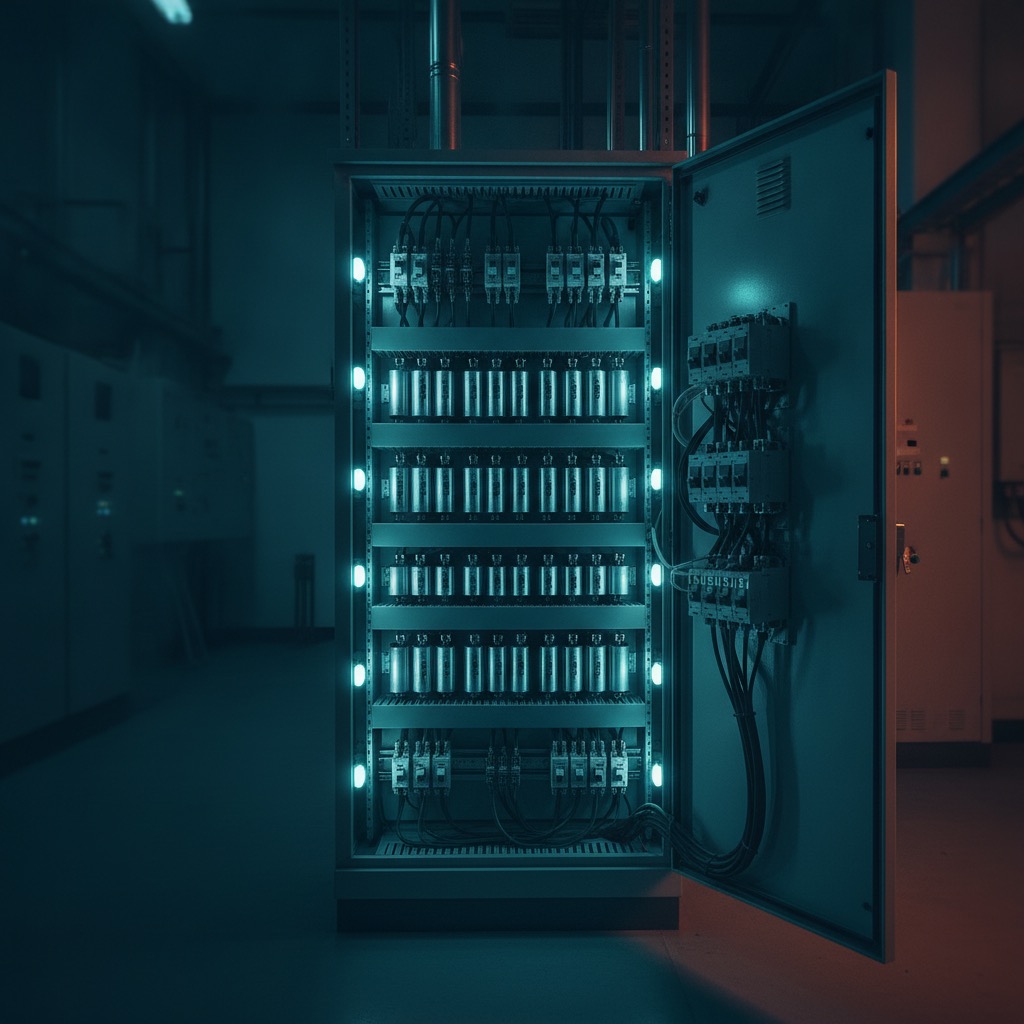
Of all the industrial energy optimization measures a plant can apply, the capacitor bank tends to be the one that pays for itself fastest. It doesn't reduce consumption in kWh —it is not an efficiency measure in the strict sense—, but it eliminates a charge that CFE applies month after month for an invisible problem: a low power factor. If your bill carries the line item for a power factor penalty, you are paying for reactive energy that a well-sized bank neutralizes. This guide is for the energy or maintenance manager who needs to decide whether to invest, how much, and what type.
What exactly does a capacitor bank correct?
A capacitor bank supplies the reactive energy that your motors, transformers, and ballasts consume to create their magnetic fields. By supplying it locally instead of drawing it from the grid, it raises the installation's power factor. The direct result: the CFE penalty for low power factor disappears and, in many cases, a credit appears.
The power factor measures how efficiently you use the energy the grid delivers to you. Inductive loads —the heart of almost any plant— consume two types of power: active (kW), which does the work, and reactive (kVAR), which produces no useful work but saturates the system's capacity. A low power factor means you are "occupying" grid capacity without using it, and CFE charges you for that waste.
The CFE penalty and the 0.90 target
CFE sets the threshold at a power factor of 0.90. Below that value it applies a surcharge; above it, a credit. The CFE power factor penalty is calculated with a formula on the billable energy and demand amount for the period.
According to CFE's tariff provisions, when the power factor (PF) is below 0.90, the surcharge percentage is:
Surcharge % = (3/5) × ((0.90 / PF) − 1) × 100
And when the PF is equal to or greater than 0.90, a credit applies:
Credit % = (1/4) × (1 − (0.90 / PF)) × 100
The surcharge can reach up to 120% of the amount in extreme cases (very low power factors), while the maximum credit is 2.5% upon reaching a power factor of 1.0, according to sources that reproduce CFE's tariff formulas. It is also worth noting a nuance: as of recent revisions, various sector sources report that for users on high voltage or with contracted demand equal to or greater than 1 MW the minimum threshold may have risen from 0.90 to 0.95; verify the criterion applicable to your tariff before setting the target. If you want to see the impact in pesos with your own bill, use the CFE power factor and penalty simulator.
How is a capacitor bank sized in kVAR?
The size of the bank is calculated with your plant's active power (kW) and the difference between your current power factor and the target. The formula is kVAR = kW × (tan φ₁ − tan φ₂), where φ₁ is the angle of the current power factor and φ₂ that of the target. The worse the initial power factor, the more kVAR you need and the greater the recovered saving.
In practice, the calculation starts from your bill and a measurement. You need the active demand (kW), the average power factor for the period, and the target you want to reach (typically 0.95 to 0.98 to guarantee a credit and leave a margin). The multiplier factor (tan φ₁ − tan φ₂) is taken from a table or calculated directly.
Sizing example
A plant with 1,200 kW of demand, a current power factor of 0.90 and a target of 0.98 requires on the order of 400 kVAR of compensation, according to the technical example from EINDUS. With a worse starting point —for example 0.78— that same 1,200 kW motor would demand considerably more kVAR, which makes the bank more expensive but also boosts the saving, because the penalty you were paying was much higher.
A practical rule: never size based on the bill alone. Demand and power factor vary throughout the day and the month. A measurement of at least one billing cycle —ideally with hourly logging— avoids oversizing (risk of overcompensation during low-load hours) or falling short.
Fixed, automatic, or with filters: which one do you need?
It depends on how your load varies and how much harmonic distortion your installation has. A fixed bank works when the reactive load is stable; an automatic one, when it varies throughout the day; and one with reactors or filters, when there is power electronics that generates harmonics. Choosing the wrong type is the number one cause of banks that burn out or underperform.
Fixed bank
It delivers a constant amount of kVAR. It is the most economical option and works well to compensate loads that are always on —a transformer, a large motor in continuous operation— in installations with low harmonic distortion. As a market reference, various manufacturers recommend fixed banks when the harmonic content is low, on the order of less than 5% voltage THD.
Automatic bank
It switches capacitors in steps (stages) through a controller that measures the power factor in real time and connects or disconnects contactors as needed. It is the right choice when your load varies —shifts, lines that start and stop, intermittent processes—, because it avoids overcompensation during off-peak hours, which is also penalized. An important technical detail: capacitor-switching contactors must include pre-insertion resistors to limit the connection (in-rush) current, or they degrade quickly.
Bank with detuning reactors or harmonic filters
When the plant has variable frequency drives, rectifiers, induction furnaces, or a lot of power electronics, the picture changes. That equipment injects harmonic currents, and a conventional capacitor bank can enter resonance with the grid: it amplifies the harmonics instead of filtering them, deteriorates the capacitors at an accelerated rate, and trips protections. The solution is a bank with detuned (blocking) reactors connected in series with the capacitors, which shift the resonance frequency away from the critical harmonics. In cases of severe distortion, dedicated harmonic filters are required.
When to suspect harmonics? If you have a high proportion of non-linear loads, unexplained trips, transformer overheating, or capacitors that fail prematurely. The technical reference is the IEEE 519 standard, which sets the recommended harmonic distortion limits at the common coupling point. That's why, before buying a bank, a power quality study is advisable; it is the same principle of coordination required by the Grid Code on large loads.
What is the real ROI of a capacitor bank?
The payback of a capacitor bank tends to be between 6 and 18 months, and it is one of the shortest in energy optimization. The key is counterintuitive: the worse your current power factor, the better the ROI, because the penalty you eliminate is greater. A plant with a power factor of 0.75 recovers the investment much faster than one at 0.88.
The reason is direct. The saving doesn't come from consuming less energy, but from erasing a surcharge percentage applied to your entire energy and demand bill. If that surcharge was high —because your power factor was very low—, the bank pays for itself in a few months. If your power factor was already near the threshold, the bank is still worth it (you capture the credit), but the return is longer.
Estimated payback table by current power factor
The following table is illustrative, for a hypothetical plant of ~1,000 kW with an electricity bill on the order of $1,800,000 MXN per month. The amounts are estimated with a qualifier and depend on your tariff, your node, and your load profile; they serve to show the pattern, not to quote.
| Current PF | Approx. CFE surcharge | Estimated monthly penalty (MXN) | Typical bank investment (MXN) | Estimated payback |
|---|---|---|---|---|
| 0.70 | ~17% | ~$300,000 | ~$650,000 | ~2-3 months |
| 0.78 | ~9% | ~$165,000 | ~$520,000 | ~3-4 months |
| 0.85 | ~3.5% | ~$63,000 | ~$420,000 | ~6-7 months |
| 0.88 | ~1.4% | ~$24,000 | ~$360,000 | ~14-16 months |
| ≥ 0.90 | 0% (credit) | credit of up to ~2.5% | ~$320,000 | return through credit |
The surcharge is estimated with the CFE formula (3/5 × ((0.90/PF) − 1) × 100) applied to the energy and demand amount; the investment and payback are reference ranges. The message is clear: if your power factor is below 0.85, the bank is almost always one of the shortest-return projects at your plant. Place it in context within the 10 efficiency measures ranked by ROI.
Decision criterion: fixed vs automatic vs with filters
| Plant scenario | Recommended type | Why |
|---|---|---|
| Stable reactive load, low harmonic distortion | Fixed bank | Minimal investment; compensates a constant load |
| Variable load (shifts, intermittent processes) | Automatic step bank | Avoids overcompensation during off-peak hours |
| Drives, rectifiers, power electronics | Bank with detuned reactors | Prevents resonance and harmonic degradation |
| Severe harmonic distortion (high THD) | Dedicated harmonic filters | Complies with IEEE 519 and protects the whole system |
How does Enerlogix avoid overinvesting or falling short?
As an independent energy consultancy, Enerlogix doesn't sell equipment: it sizes with your real measurement and recommends the type of bank you truly need, no more and no less. We characterize your load profile, verify whether there are harmonics that require reactors or filters, calculate the exact kVAR, and project the payback with your tariff. Our only product is the recommendation, not the sale of the bank.
This matters because the market is full of suppliers that quote a fixed bank where an automatic one was needed, or one without reactors where there were harmonics —and the customer ends up with equipment that burns out or underperforms—. The installation of the bank is carried out by an integrator; our role is to ensure the technical decision and the investment are correct within your Plan 360 Management.
Request a free evaluation or learn about the energy optimization service. We work with your real bill and measurement.
Frequently asked questions
The investment depends on the required kVAR, the type (fixed, automatic, or with filters), and whether harmonics need correcting. The typical payback runs from 6 to 18 months and is one of the shortest in energy optimization. The worse your current power factor, the faster you recover the investment, because the CFE penalty you eliminate is greater.
The CFE threshold is 0.90. Below that value a surcharge applies on the billable energy and demand amount, and above it a credit of up to 2.5%. Various sources report that for users on high voltage or with demand equal to or greater than 1 MW the minimum may have risen to 0.95, so it is worth verifying the criterion for your tariff.
They are calculated with the formula kVAR equals kW times the difference of tangents between your current power factor and the target, using your real active demand. The correct approach is to size with a measurement of at least one billing cycle, not just the bill, so as not to oversize or fall short against a load that varies during the day.
When your plant has variable frequency drives, rectifiers, induction furnaces, or a lot of power electronics. That equipment generates harmonics that can enter resonance with a conventional bank, amplify the distortion, and burn out the capacitors. In that case detuned reactors or dedicated filters are used, in accordance with the IEEE 519 technical reference.
Use a fixed bank if your reactive load is stable and the harmonic distortion is low, because it is the most economical option. Use an automatic step bank if your load varies by shifts or intermittent processes, since it connects and disconnects capacitors as needed and avoids overcompensation during low-load hours, which is also penalized.